

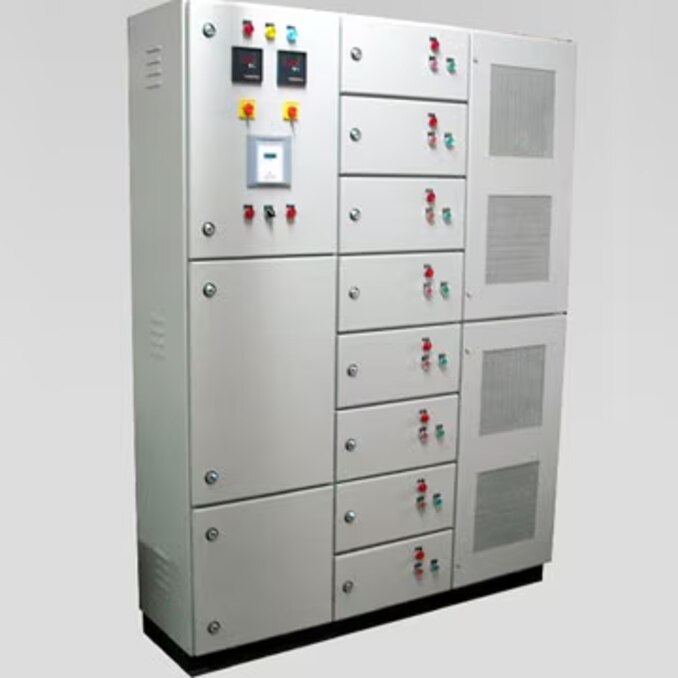
The lowest quotation does not tell you whether a panel will withstand the site fault level, fit the installation, pass inspection, or receive support after energisation. By the end, you will have a practical method for defining the panel, checking a manufacturer’s evidence, comparing quotations, and controlling the order through testing and commissioning.
Key takeaways
- State voltage, current, fault level, IP rating, dimensions, and operating environment.
- Request IEC 61439 evidence, routine test records, and certification documents.
- Compare component traceability, busbar workmanship, wiring quality, and inspection controls.
- Put drawings, test reports, manuals, spares, and site support in the quotation.
Start with the electrical and physical requirements
Define the panel’s electrical duty before asking an electrical panel manufacturer for a quotation. A vague description such as “400 A control panel” hides the information that determines enclosure size, busbar design, protection, and price.
1. Issue the latest single-line diagram, showing the incoming supply, voltage, phases, frequency, transformer details, incomers, bus couplers, outgoing feeders, motor starters, drives, and protective devices.
2. Attach a load schedule with connected load, demand load, full-load current, starting current, diversity assumptions, power factor, and spare capacity. Identify continuous loads and loads that must remain operational during a utility failure.
3. State the available fault current at the installation point and the required short-circuit current rating. In the United States, specify the panel SCCR separately from the incoming breaker’s interrupting rating; NEC Article 409 requires the industrial control panel to carry an adequate SCCR marking.
4. Specify the operating environment: indoor or outdoor location, ambient temperature, altitude, humidity, dust, corrosive exposure, hazardous-area class or zone, gas or dust group, and temperature classification. A high IP or NEMA rating alone does not make a panel suitable for a hazardous location.
5. Define the physical constraints: maximum height, width, and depth; cable-entry direction; gland-plate arrangement; floor, wall, or skid mounting; door clearance; lifting access; maintenance space; busbar access; and required IP rating.
6. Name the governing standards and jurisdiction, such as IEC 61439, IEC 60204-1, NFPA 79, NEC, or specified IS standards, and state the required form of separation, metering, communications, spare ways, and service access.
Send drawings, cable data, control-voltage details, component preferences, and site-delivery requirements with the enquiry. Manufacturers then quote the same duty instead of pricing different assumptions.
Verify standards, ratings, and certification evidence
A suitable panel is proven against the project’s fault level, voltage, environment, and governing code—not by a quotation that says “built to standards.” Request the exact edition and compliance basis: IEC 61439 for the assembly, IEC 60204-1 or NFPA 79 for machinery, IEC 60947 for applicable switchgear, and the specified IS standards for Indian projects.
Confirm which jurisdiction governs before comparing certificates.
For an IEC 61439 assembly, ask for design-verification evidence from the assembly manufacturer, not only certificates for breakers or busbars. Request:
- Design verification for temperature rise, dielectric properties, short-circuit withstand, protective-circuit effectiveness, clearances, creepage distances, and mechanical operation
- Routine-verification records for the completed panel, including protective-bond continuity and functional checks
- A rating schedule showing busbar current, insulation voltage, enclosure IP rating, form of separation, and short-circuit rating
Check the panel’s short-circuit current rating, or SCCR, against the available fault current at its installation point. In the United States, NEC Article 409 requires an industrial control panel to carry an SCCR marking; the incoming breaker’s interrupting rating does not replace it.
Treat certification labels as configuration-specific evidence. A UL 508A label applies only when the enclosure, wiring methods, components, conditions of acceptability, and substitutions match the supplied panel. For hazardous locations, verify the stated class, division or zone, gas or dust group, and temperature class; a high NEMA or IP rating alone does not establish suitability.
Examine engineering, component control, and fabrication quality
Ask for the design-verification record for the proposed IEC 61439 assembly, not merely certificates for its breakers or enclosure. It should cover temperature rise, dielectric properties, short-circuit withstand, protective-circuit effectiveness, clearances and creepage distances, and mechanical operation. Request the routine verification procedure and completed sample records showing how every production panel is checked.
Require these controls before approving the design:
- A controlled bill of materials linked to approved drawings, including exact component part numbers, busbar sizes, terminal blocks, enclosure accessories, and wiring methods.
- A formal deviation process requiring engineering approval for substitutions. Replacing a protective device, power supply, disconnect, or busbar can change SCCR, heat dissipation, EMC performance, clearances, and certification validity.
- An SCCR calculation that considers low-rated branch components, terminal blocks, supplementary protectors, disconnects, and any documented series combination under UL 508A. The highest-rated device alone proves nothing.
- Thermal calculations using the actual losses from drives, transformers, contactors, power supplies, and PLC equipment at the specified ambient temperature.
- Evidence that the ventilation method preserves the required IP rating under IEC 60529. A larger enclosure or an added fan does not prove acceptable temperature control.
Fabrication evidence includes approved general-arrangement and wiring drawings, controlled work instructions, torque records, inspection checkpoints, and photographs or references from comparable assemblies. Check that the manufacturer’s UL 508A construction details, component conditions of acceptability, enclosure, wiring methods, and approved substitutions match your supplied panel; uncontrolled changes can invalidate the label’s certification basis.
Define inspection, testing, documents, and site support
Acceptance requires documented factory acceptance testing, verified electrical performance, complete records, and commissioning support—not a visual check and a delivery note.
1. Agree a repeatable factory acceptance testing procedure before manufacture. Witness point-to-point I/O checks, protective-bond continuity, insulation resistance testing, dielectric withstand testing where applicable, device settings, functional sequences, alarms, interlocks, and local or remote control operation.
2. Require signed test sheets showing the panel identification, test instruments and calibration dates, measured values, acceptance limits, witness signatures, and every discrepancy. Do not accept an open punch list; require evidence that each defect was corrected and retested.
3. Request the final document pack: approved and as-built drawings, single-line and wiring diagrams, terminal schedules, bill of materials, datasheets, protection-setting records, operating instructions, maintenance requirements, spare-parts list, and test certificates. For an IEC 61439 assembly, obtain the manufacturer’s design-verification and routine-verification evidence, not only component certificates.
4. Confirm the nameplate shows the applicable ratings, including enclosure IP rating, busbar rating, insulation voltage, and short-circuit current rating. For a U.S. installation, verify the SCCR suits the available fault current; the incoming breaker’s interrupting rating does not establish the panel’s SCCR.
5. Define commissioning support in the purchase order: remote troubleshooting, an engineer at site for energisation and I/O proving, setting verification, operator handover, and a dated close-out report. Ensure the manufacturer provides support when field wiring or equipment interfaces expose a factory-hidden fault.
Compare manufacturers on evidence, not promises
A low quotation proves only that a supplier priced the listed items. Dependability appears in controlled design records, traceable production, and accountable support after delivery. Require a controlled bill of materials and a formal deviation process; an undocumented substitution can alter SCCR, clearances, heat dissipation, EMC performance, and certification validity.
| Evidence | Dependable manufacturer | Quotation-led supplier |
|---|---|---|
| ISO 9001 certification scope | Certificate scope covers electrical panel design and manufacture at the stated facility | Certificate is displayed without its scope or site details |
| In-house engineering | Named engineers provide drawings, calculations, design reviews, and IEC 61439 design-verification evidence | Sales staff provide a generic compliance statement |
| Panel-building experience | Supplies references for comparable ratings, industries, enclosure forms, and site conditions | Shows unrelated fabrication work or only a product catalogue |
| After-sales service | Contract names response contacts, spare-parts responsibility, commissioning support, and warranty limits | Support ends with dispatch or depends on an unnamed subcontractor |
Check that a UL 508A label covers the supplied construction, wiring methods, enclosure, components, approved substitutions, and SCCR; the label alone is not blanket approval. For IEC 61439, request the applicable design-verification records because the assembly manufacturer completes design and routine verification.
If you are assessing Param Controls, apply the same test to its in-house engineering records, comparable panel-building experience, and after-sales service commitments rather than accepting its quotation at face value. For hazardous locations, demand certification matching the class, division or zone, gas or dust group, and temperature class.
Frequently asked questions
What electrical and physical requirements should you give a panel manufacturer?
Define the system voltage, full-load current, prospective short-circuit current, protection scheme, enclosure dimensions, IP rating, cable entry, ambient conditions, and installation location before requesting a quotation.
How can you verify an industrial panel manufacturer’s standards and ratings?
Ask for the applicable IEC 61439 design and routine verification evidence, enclosure IP rating details, short-circuit withstand information, component datasheets, and copies of relevant certificates or test reports.
What quality evidence should you examine before selecting a manufacturer?
Check approved drawings, component brand and model control, material traceability, busbar clearances, crimped terminations, wire numbering, torque records, and inspection photographs or reports.
Which documents and tests should be included with an electrical panel?
Specify final schematics, wiring diagrams, bills of materials, terminal schedules, settings, manuals, test certificates, insulation and continuity results, functional test records, and site commissioning support.